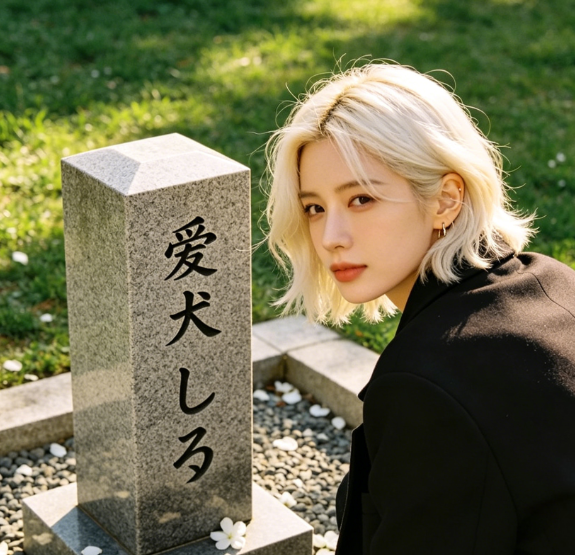
Japanese Design Philosophy
Japanese pet tombstone design is deeply influenced by Zen Buddhism and Shinto. It pursues not “grandeur” or “ornateness,” but “stillness” and “harmony.” A good Japanese tombstone blends into nature rather than standing out.
Characteristics: minimalist lines, natural materials, restrained decoration.
Material: Natural Stone Preferred
The most common stones for Japanese pet tombstones are granite and andesite.
- Granite: Durable, calm colors (gray, black, beige). Surfaces are often flamed or chiseled, not highly polished.
- Andesite: A volcanic stone, gray‑green or dark gray, fine‑grained. Often used for small stones.
Difference from Western stones: Western tombstones favor high polish (mirror‑like shine). Japanese stones retain natural texture, even故意保留 cracks and imperfections — these are called “wabi‑sabi,” the beauty of imperfection.
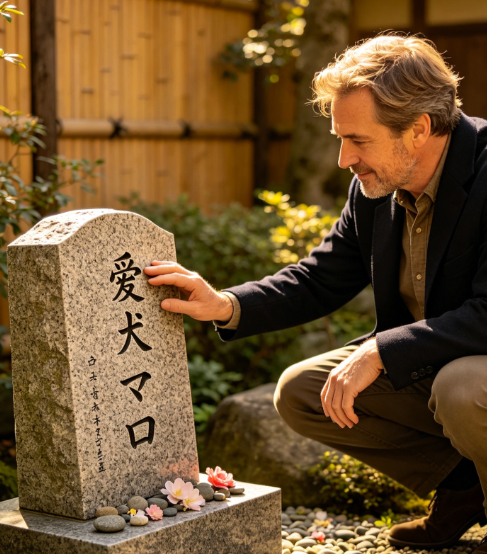
Shapes: Simple but Not Simple
Five‑ring pagoda (Gorintō): The most traditional Japanese tombstone shape, from Buddhism. It has five stacked shapes representing earth, water, fire, wind, and void. For pets, the size is reduced and the curves softer.
Natural stone: Unprocessed, uncut — just a naturally shaped stone. Only the pet‘s name and date are engraved on the front. This style best expresses “Zen.”
Square pillar: A minimalist rectangular box with a slight curve at the top. Only text, no extra decoration.
Flat stone: A flat natural stone slab placed directly on the ground. Engraved with the pet’s name. Moss can grow around it. The most unobtrusive, nature‑integrated style.
Engraving Style: Less Is More
Japanese tombstones are very restrained. Usually only the pet‘s name (sometimes with “no haka” meaning “grave of”) and the year of death. No complex fonts — mostly kaisho (regular script) or gyosho (semi‑cursive), occasionally Mincho (similar to serif).
No full birth‑death dates? Many Japanese stones only engrave the year of death (e.g., “Reiwa 6”), omitting month and day. This emphasizes accepting death rather than clinging to specific moments.
No epitaphs. Japanese stones rarely engrave poems like “Forever in our hearts.” They believe the stone itself is the epitaph.
Surroundings: Moss, Stone Lanterns, Water Basins
A Japanese tombstone is not isolated. It often comes with moss, a stone lantern, and a water basin to form a miniature landscape.
- Moss: Covers the ground around the stone, symbolizing the passage of time and nature‘s embrace.
- Stone lantern (tōrō): Placed beside the stone, lit at night. The lantern’s light represents Buddha‘s compassion.
- Water basin (chōzubachi): A small stone basin with water. Visitors can use a wooden ladle to pour water over the stone (symbolizing purification).
Pet Temples in Japan
Many Japanese temples offer permanent spirit tablets for pets. Manpuku‑ji in Tokyo is one example. Pets are buried in temple cemeteries, and priests conduct the stone‑placing ceremony. On specific days, temples hold collective memorial services for all pets. Owners can visit regularly, offering flowers and treats.
If your beloved companion deserves a unique and eternal memorial, please visit our 【Product Page】(https://petheadstone1.com/) or create a custom pet memorial stone for your pet through our 【Customization Service】(https://petheadstone1.com/).
Pet gravestone#Pet memorial stone#Pet headstone#Pet marker#Pet grave marker#Pet memorial plaque